 Frank Schwab
Digital Hubris and the £349 Million Mirage — The Collapse of the Co-operative Bank’s IT Transformation
Executive Summary: The Price of Technical Hubris The 2013 near-collapse of the Co-operative Bank stands as a landmark case in the history of financial services, representing a total failure of governance, risk management, and digital strategy. While the public narrative focused on a £1.
 Frank Schwab
Independent board director and strategic advisor Published
March 16, 2026

Executive Summary: The Price of Technical Hubris
The 2013 near-collapse of the Co-operative Bank stands as a landmark case in the history of financial services, representing a total failure of governance, risk management, and digital strategy. While the public narrative focused on a £1.5 billion capital "black hole," the structural catalyst for this ruin was the catastrophic failure of the Banking Transformation Programme (BTP). Designed to "leapfrog" the UK’s "Big Four" banks by replacing antiquated 1970s-era legacy systems with a modern digital core, the project instead consumed £349 million in cash before being abandoned in a state of total paralysis.
The resulting £298.4 million impairment charge was a direct hit to the bank's regulatory capital at its most vulnerable moment. This failure, compounded by a toxic merger and a "good news" corporate culture, forced the UK’s premier "ethical" mutual to surrender 70% of its equity to US-based hedge funds. This case study examines how a lack of board-level technical literacy and the "brave" pursuit of a "big bang" IT replacement led to one of the costliest digital disasters in banking history.
I) A Legacy of "1970s Engines"
By the mid-2000s, the Co-operative Bank was operating on a precarious foundation. Its core systems were a patchwork of 1970s-era technology that were "product-centric" rather than "customer-centric." This meant the bank had no "single view" of its customers; a person with a mortgage, a current account, and a savings account existed as three separate, unrelated entities across different databases.
🔹 Operational Paralysis: A simple customer request, such as a change of address, required manual intervention across 20 different legacy systems.
🔹 System Fragility: During the 2008 financial crisis, the bank—acting as the primary clearing bank for Northern Rock—almost suffered a total system blackout due to the surge in transaction volumes. Internal reports warned that the bank was "running on fumes" technologically.
🔹 The "Leapfrog" Ambition: Rather than incrementally patching these systems, management embarked on a "brave" strategy to install Infosys Finacle. They sought a "Bank in a Box"—a ready-made solution that would theoretically provide a modern platform with minimal local tailoring.
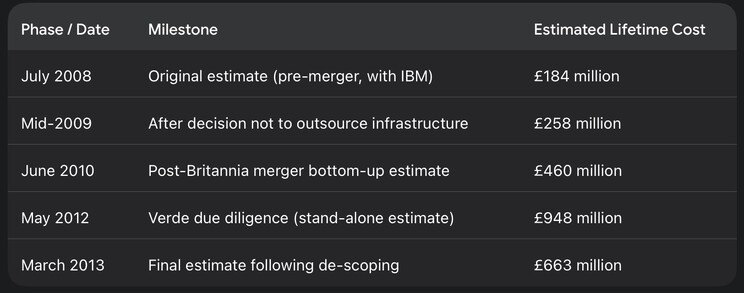
🔹 The Selection Gap: In July 2008, the Board approved an initial budget of £184 million for the Banking Transformation Programme. However, they chose a platform that had never been successfully implemented in a full-service UK retail bank, ignoring the immense complexity of UK-specific regulatory and clearing requirements.
II) Anatomy of a Failed Execution
The execution of the BTP was characterized by a "command and control" management style that suppressed dissent and consistently underestimated technical complexity.
a) The Britannia Merger: Doubling the Risk (2009)
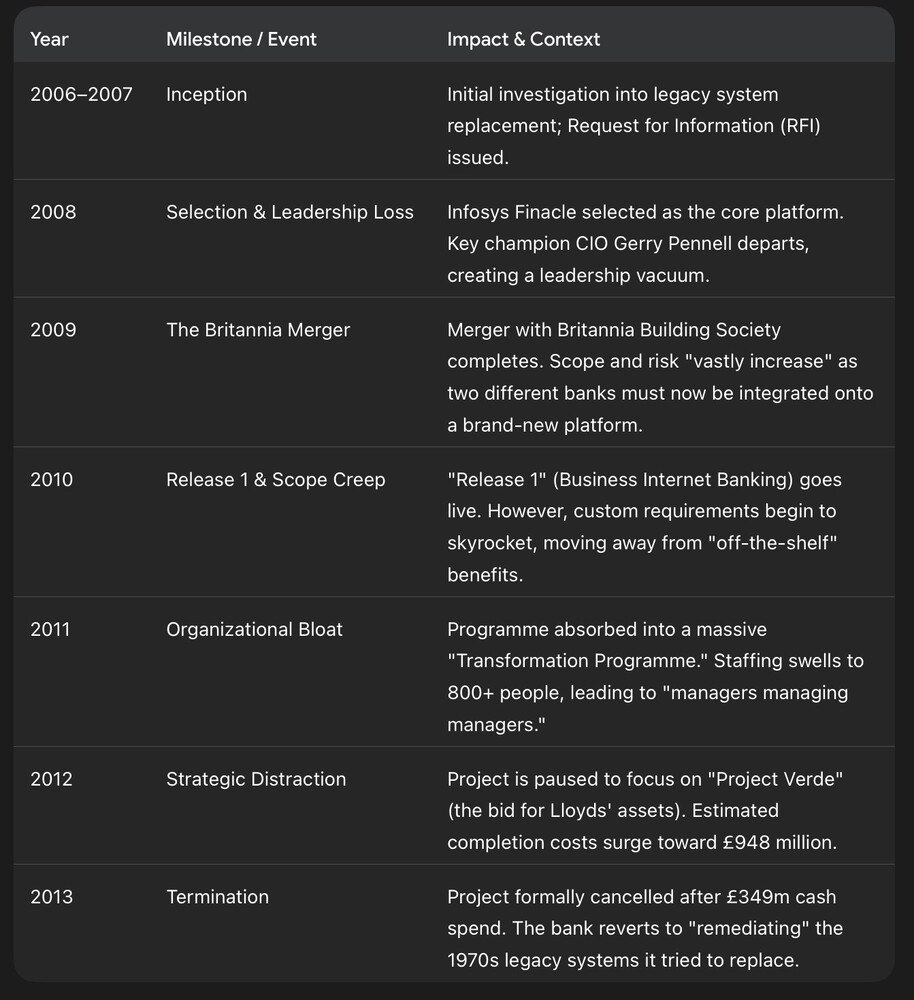
The August 2009 merger with Britannia Building Society was described by Sir Christopher Kelly as the "fatal blow" to the IT project. Industry best practice suggests migrating a smaller entity onto a larger entity's existing platform. Instead, the Co-op Bank attempted a high-risk "double migration," trying to move both organizations onto a brand-new platform simultaneously.
🔹 Scope Creep: The project team was suddenly forced to account for 3 million additional Britannia customers and a £3.7 billion commercial property loan book.
🔹 Cultural Friction: The merger created "personal animosity" between legacy Co-op and Britannia IT staff, leading to a dysfunctional "managers managing managers" culture where technical progress was secondary to internal politics.
b) The Requirements Trap and Organizational Bloat
The bank fell into the classic "customization trap." Instead of simplifying their business to fit the software, they spent millions trying to force the modern software to mimic their inefficient legacy processes.
🔹 Requirement Explosion: The bank identified an initial 18,000 requirements. After a desperate "de-scoping" exercise in 2010 reduced this to 11,000, "scope creep" pushed the number back up to 17,000 by late 2011.
🔹 Personnel Bloat: At its peak, the project employed over 800 staff and contractors. The overhead of coordinating such a massive team meant that communication consumed more resources than actual software development.
c) Financial "Smoke and Mirrors" and the Verde Distraction
To protect the bank’s fragile capital ratios, management used a service company called CFSMS to fund the project. This allowed them to "capitalize" the IT spending as an asset on the balance sheet, delaying the realization of the loss.
🔹 Capital Masking: By October 2010, the bank stopped deducting BTP costs from its regulatory capital, making its financial position appear £252 million stronger than reality.
🔹 Project Verde: While the IT project was failing, management became obsessed with buying 632 branches from Lloyds Banking Group. This "Project Verde" cost the bank £73 million in advisory fees and diverted the Board’s attention at the exact moment the BTP required emergency intervention.
III) The Result: Final Collapse and Loss of Control
By 2013, the reality of the failure was undeniable. The BTP was no longer a strategic asset but a sinking anchor.
🔹 The Impairment: The bank was forced to write off £150 million in late 2012, followed by a final £148.4 million in 2013. Only "Release 1" (an internet banking interface) was ever delivered.
🔹 Total Financial Loss: The bank reported a staggering £1.3 billion loss for 2013. The IT failure was the single largest "self-inflicted" component of this loss, alongside £802 million in Britannia loan impairments and £347 million in PPI mis-selling provisions.
🔹 The Bail-In: Because the Co-operative Group could not afford a £1.5 billion rescue, the bank was "bailed in" by US hedge funds (including Silver Point and Aurelius). The Group’s ownership was diluted from 100% to 30%, and eventually to near-zero, ending 140 years of mutual ownership.
IV) A Masterclass in Governance Failure - Five Lessons to Learn
1️⃣ Board Competency is Non-Negotiable
The Kelly Review found that the Board consisted of "lay members" who lacked the technical literacy to challenge management. A board overseeing a bank must have deep technical and financial expertise.
2️⃣ Beware the "Big Bang" Modernization
Large-scale, all-at-once IT replacements are inherently high-risk. Successful modern banks now favor "incremental modernization"—replacing legacy systems piece-by-piece.
3️⃣ The Sunk Cost Fallacy
Management continued to pour millions into the BTP long after external reviews from Deloitte and KPMG flagged it as "high risk of failure." They were "trapped by their own optimism."
4️⃣ Culture Trumps Strategy: The "good news culture" meant that red flags were suppressed. Internal Audit was marginalized, and the "three lines of defense" existed only on paper.
5️⃣ Due Diligence is Mandatory The "cursory" due diligence performed on the Britannia merger was a fatal error. High concentration risk in commercial property should have been a "bombshell" warning at the time of the merger.
V) References & Further Reading
The Kelly Review (2014): Report of the independent review into the events leading to the Co-operative Bank's capital shortfall
FCA Final Notice (2015): The Financial Conduct Authority censures the Co-operative Bank for listing rules breaches and failing to be open with the regulator
BBC Business: Co-op Bank loss hits £1.3bn for 2013
The Guardian: Co-operative bank scandal blocked shake-up of banking, say MPs
FrankSchwab.de
Originally published on LinkedIn
Reply to Frank →Notes for boards, investors and technology leaders.
Occasional essays on banking technology, governance and the decisions that carry the most enterprise value. Sent by Frank, no third parties involved.