 Frank Schwab
The End of "Vibes", The Rise of "Value": Why Crypto Fees are the New P/E Ratio
For years, the crypto market was driven by what I call "Narrative Alpha"—the ability to tell a compelling story about the future. But as we cross into Q1 2026, the game has fundamentally changed.
 Frank Schwab
Independent board director and strategic advisor Published
March 26, 2026

For years, the crypto market was driven by what I call "Narrative Alpha"—the ability to tell a compelling story about the future. But as we cross into Q1 2026, the game has fundamentally changed. The "tourists" have left, the institutions have arrived, and they brought their spreadsheets with them.
In today’s market, we are seeing a Great Convergence: Blockchains and DeFi protocols are finally being valued like the productive assets they are. If you aren’t looking at Fee Revenue and Price-to-Fee (P/F) ratios, you aren’t investing; you’re gambling.
Here are the facts and figures:
1. The Revenue League Table: Who is Actually Making Money?
Gone are the days when Ethereum was the only "profitable" chain. The landscape has decentralized, and the competition for "Global Settlement" is fierce.
Top Fee Earners (Monthly Run-Rate, Feb 2026):
👉🏼 Solana: $26.7 Million (Driven by high-velocity DEX activity and priority fees).
👉🏼 Tron: $24.4 Million (The undisputed king of USDT settlement).
👉🏼 Ethereum: $23.2 Million (A lower figure than 2021, but higher "quality" via L2 settlements).
👉🏼 Base (L2): $8.4 Million (The standout winner of the Layer 2 wars).
👉🏼 Bitcoin: $5.5 Million (Still largely a "Store of Value" with minimal fee-to-cap sensitivity).
The Bottom Line: Utility is migrating. While Ethereum remains the high-security "Vault," Solana and Tron have captured the "High-Frequency" commerce of the crypto economy.
2. Understanding the "Valuation Paradox"
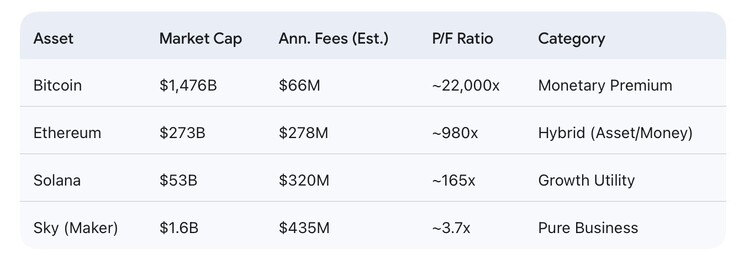
Why is Bitcoin worth $1.4 Trillion with only $5.5M in monthly fees, while Tron is worth $27B with nearly 5x that revenue? The answer lies in the P/F Ratio (Price-to-Fees).
The market applies a "Monetary Premium" to Bitcoin and Ethereum. We don’t value a gold mine just by the cost of the shovels; we value the gold. However, for "Utility Chains" like Solana and "DeFi Apps" like Sky (formerly Maker), the market is much colder. They are valued like fintech companies. A 3.7x P/F for Sky suggests the market still discounts DeFi due to regulatory "noise," despite its massive cash flows.
3. The "Productive App" Revolution
The most exciting trend in 2026 isn't the chains themselves—it's the Applications. We are seeing the rise of "Fat Applications" that out-earn the networks they sit on.
Aave: Now generating over $100M in annualized revenue. With institutional "Private Vaults" going live, Aave is trading at a 30x multiple, reflecting its status as the "Backbone of On-Chain Credit."
Uniswap: Since the 2025 "Fee Switch" activation, UNI is no longer just a governance token. It is a buy-back-and-burn machine. It programmatically converts swap fees into deflationary pressure.
Jupiter (JUP): The Solana giant is currently trading at a 1.7x P/F. This is arguably the most undervalued "Yield Rail" in the ecosystem, processing billions in volume with a direct link to token value.
4. My Outlook: The "Net-Zero" Standard
In 2026, the gold standard for a crypto project is Net-Zero Emission.
I am closely watching protocols that earn enough in fees to completely offset their token inflation. When fees > emissions, the token becomes "Hard Money." Ethereum pioneered this with EIP-1559, but now apps like Aerodrome and Meteora are perfecting it.
My Takeaway for the C-Suite and Institutional Investors:
Stop looking at "Total Value Locked" (TVL)—it’s a vanity metric that can be faked with incentives. Look at Fee Retention. If users are willing to pay to use a protocol, it has a "Moat." If it has a Moat, it has a future.
The infrastructure is built. The revenue is real.
Originally published on LinkedIn
Reply to Frank →Notes for boards, investors and technology leaders.
Occasional essays on banking technology, governance and the decisions that carry the most enterprise value. Sent by Frank, no third parties involved.